Sell Flash and Green Lantern Comics, 1940 to the Mid-1980s
The Flash and Green Lantern both arrived in 1940, faded away after the war, and came back as new heroes a few years apart. That double history makes their comics some of the most interesting finds in a family collection. If you want to sell Flash and Green Lantern comics, from the first 1940s issues to the 1960s and 1970s runs, ComicBookBuying.com will review them face to face and make a single offer.
We are a Cherry Hill, New Jersey company, and our buyers cover South Jersey, the city and suburbs of Philadelphia, and Northern Delaware. No lists or counts are needed to start.
What we buy: comics from the 1930s to the mid-1980s, in any condition, from one box to a whole basement. We don’t buy newer comics, but when we buy an older collection we take the whole lot, newer comics mixed in included, so the family isn’t left with boxes.
Free collection review · Same-day cash · No obligation · South Jersey, Philadelphia and Northern Delaware
Two Heroes, Each With Two Beginnings
Each name belongs to two different heroes, and the comics show it:
- The 1940s Flash. Jay Garrick first ran in Flash Comics #1, dated 1940, which also introduced Hawkman. He gained his own title, All-Flash, in 1941, and Flash Comics ended in 1949.
- The 1940s Green Lantern. Alan Scott first appeared in All-American Comics #16 in 1940 and received his own Green Lantern title in 1941.
- The new Flash. Barry Allen arrived in Showcase #4 in 1956. When his own series began in 1959, it picked up the old numbering at #105.
- The new Green Lantern. Hal Jordan followed in Showcase #22 in 1959, and Green Lantern #1 came out in 1960.
Both 1940s heroes were also Justice Society members, so our page on All-Star Comics fits alongside this one.
Telling the 1940s Heroes From the 1960s Ones
A quick look at a cover usually settles which hero you have:
- The costume. Jay Garrick runs in a red shirt and a round helmet with small wings, while Barry Allen wears a full red suit and mask with a lightning bolt on the chest. Alan Scott wears a cape and a high purple collar; Hal Jordan wears a green and black uniform with a small mask and no cape.
- The title. Flash Comics and All-American Comics are 1940s books. The Flash, numbered from 105 upward, began in 1959.
- The price. 10¢ fits the 1940s and 1950s, and 12¢ most of the 1960s.
- The small print. The month and year are printed in tiny type near the bottom of the first page inside.
Our comic book dating guide covers these checks step by step.
Flash and Green Lantern Firsts Collectors Want
- Flash Comics #1 (1940): the first Flash and the first Hawkman.
- All-American Comics #16 (1940): the first Green Lantern.
- Flash Comics #86 (1947): the first Black Canary.
- Showcase #4 (1956): the first Barry Allen Flash.
- Showcase #22 (1959): the first Hal Jordan Green Lantern.
- The Flash #110 (1959): the first Kid Flash.
- Green Lantern #7 (1961): the first Sinestro.
- The Flash #123 (1961): the old and new Flash meet in the story called Flash of Two Worlds.
- Green Lantern #76 (1970): the start of the Green Lantern and Green Arrow stories drawn by Neal Adams.
Collectors call books like these key issues. Few boxes contain the earliest ones, and ordinary issues of both heroes are welcome too. Our page on what a key issue comic is has more background.
Why Showcase #4 Matters
Many collectors date the start of the Silver Age to Showcase #4 in 1956. Editor Julius Schwartz gave the Flash a new identity, and the success of that idea led DC to reinvent Green Lantern and other 1940s heroes, then to bring them together in the Justice League of America in 1960.
That is why a box of late 1950s and early 1960s DC comics can matter more than its plain covers suggest. Our guides to comic book ages and to Silver Age comics explain where these years fit.
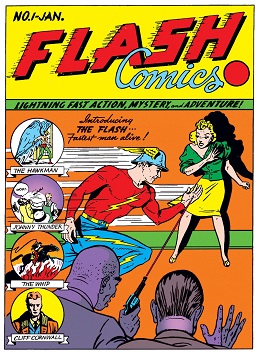
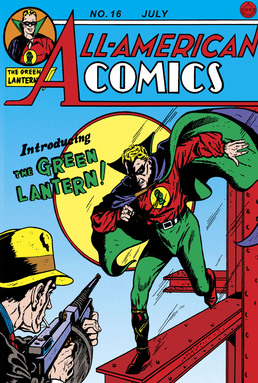
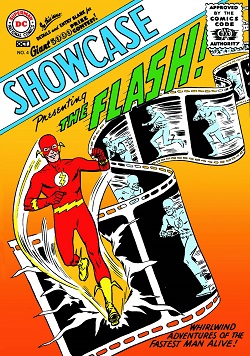
Covers shown to help you recognize the books. The characters and cover art are trademarks and copyrights of DC.
Keep Long Runs Together
Plenty of readers bought The Flash and Green Lantern month after month, so long runs from the 1960s into the 1980s turn up often. The Flash kept going until #350 in 1985, and Green Lantern teamed up with Green Arrow in the early 1970s before the series paused and later returned.
Please leave each stack in the order you found it. When a few covers that look special are pulled out, the run loses its shape before an experienced eye has seen it. We look at every box together, without cherry-picking.
What We Say About Condition
Old paper turns tan, spines split, and covers come loose. Writing, tape and water stains show up too, and condition does affect our offer. We will tell you what we see in plain words. A worn 1940s Flash Comics or a well-read 1960s Green Lantern can still be worth our time, so please do not clean, flatten or repair anything first.
Our page on damaged comics explains why repairs usually do more harm than good, and our storage guide has simple ways to keep the boxes safe until the review.
One Offer, Then the Choice Is Yours
Send a few phone pictures through our contact form, or call (856) 438-8222 for South Jersey, (215) 390-0020 for Philadelphia and the Pennsylvania suburbs, or (302) 414-0544 for Northern Delaware. We review the whole collection, in photos or in person, and name one wholesale offer, because we resell to collectors gradually. Agree to it and cash is handed over at the appointment; turn it down and that is the end of it.
We do not buy comics from after the mid-1980s by themselves, but any mixed into the boxes go with the whole lot. Our page on selling on eBay or to a buyer compares the two routes fairly.
Common Questions
Why does The Flash start at issue #105?
When Barry Allen's own title began in 1959, DC continued the numbering of the old Flash Comics, which had stopped at #104 in 1949.
Is my Green Lantern comic from the 1940s or the 1960s?
Look at the hero. A cape and high collar mean the 1940s Alan Scott, and a green and black uniform with no cape means the 1960s Hal Jordan.
Do you buy Showcase comics?
Yes. Showcase from the 1950s and 1960s introduced several heroes, and we buy it along with other DC titles up to the mid-1980s.
Do you buy Flash or Green Lantern comics from after the mid-1980s?
Not on their own. Newer issues packed with older comics come along as part of the whole lot.
Do the comics need to be in good shape?
No. Worn copies are welcome. Leave them as they are and include them in your photos.
Local Comic Book Buyers Serving Greater Philadelphia
We buy in person, by appointment, within about two hours of our Cherry Hill, New Jersey base. Call the team closest to you.
South Jersey and Cherry Hill
Camden, Burlington and Gloucester counties and the rest of South Jersey.
Philadelphia and PA Suburbs
Philadelphia and the surrounding Pennsylvania suburbs.
Northern Delaware
Wilmington and the surrounding Northern Delaware communities.
Get a Free Collection Review
Send a few photos or call. Same-day cash, no sorting and no obligation to sell.