
Sell Amazing Spider-Man Comics Without the Guesswork
Spider-Man’s early appearances are among the books we most want to find. If you are trying to sell Amazing Spider-Man comics that turned up in an attic, a parent’s closet or an old bedroom, ComicBookBuying.com can look at them in person and make an offer.
We are a local buyer based in Cherry Hill, New Jersey, serving South Jersey, Philadelphia and its Pennsylvania suburbs, and Northern Delaware. Spider-Man sits at the heart of our interest in 1960s Marvel comics. You do not need to know issue numbers or grades; this page simply shows you what to look for.
What we buy: comics from the 1930s to the mid-1980s, in any condition, from one box to a whole basement. We don’t buy newer comics, but when we buy an older collection we take the whole lot, newer comics mixed in included, so the family isn’t left with boxes.
Free collection review · Same-day cash · No obligation · South Jersey, Philadelphia and Northern Delaware
How to Spot Early Amazing Spider-Man Issues
The early issues matter most, and they are easier to spot than you might think. Three clues do most of the work:
- A low issue number. The number usually sits in a small box near the top-left corner of the cover. The series began with #1 in 1963, so the lower the number, the older the book.
- A 12¢ price. Marvel charged 12¢ for most of the 1960s and moved to 15¢ in late 1969, so a 12¢ Spider-Man cover means a 1960s copy.
- A 1960s date. Look for a line of very small print at the bottom of the first inside page. It names the publisher and gives a month and year.
If you find a stack where the numbers climb one after another, leave that box intact. It is probably a run, and it deserves a careful look.
Amazing Fantasy #15 and Amazing Spider-Man #1
Spider-Man did not start in his own comic. He first appeared in Amazing Fantasy #15 in 1962, a different title with Amazing Fantasy across the top. If you ever see that cover in a family collection, keep it flat, keep it dry and get in touch before doing anything else.
His own series, Amazing Spider-Man, began with #1 in 1963. Both books are key issues, meaning first appearances or other landmark issues that collectors want most. Even a worn copy of either one is a serious book, so never assume a rough cover makes it worthless.
Helpful guides: What Is a Key Issue Comic? explains why a few books in a stack can matter more than the rest, and Comic Book Grading Explained covers the 10-point scale and the flaws that lower a grade.
Runs of Amazing Spider-Man: Why the Whole Stack Counts
Plenty of readers did not buy one Spider-Man comic; they bought one every month. The result is a long run, meaning a stretch of consecutive issue numbers. A run of 1960s and 1970s Amazing Spider-Man is one of the collections we are happiest to see.
A run gives a collector the story in order, and it often contains landmark issues that are easy to overlook. When you sell Amazing Spider-Man comics to us, we look at the collection as a whole and do not cherry-pick, so please leave everything in the boxes it came in rather than pulling out the issues you think are special.
Later Issues: Bronze Age Spider-Man Like #129
Collectors often call the 1970s and early 1980s the Bronze Age. We buy Amazing Spider-Man from those years too, and important first appearances and long runs matter most. The clearest example is Amazing Spider-Man #129 from 1974, the first appearance of the Punisher. Our page on 1970s Marvel comics lists other first appearances from those years.
A cover price of 15¢ or more points to late 1969 or later. If your stack runs from the 1960s into the 1970s, that continuity is a plus. Our Bronze Age comics page covers that era in more depth.
Spider-Man comics from after the mid-1980s are a different story. We do not buy newer Spider-Man comics on their own, and we would rather tell you that up front. Mixed in with older ones, they are no problem: we take the whole lot.
Amazing Spider-Man Key Issues We Look For
A key issue is a first appearance or another landmark that collectors want most. In the early Spider-Man books almost every issue brought in someone who mattered for decades, so collectors treat the first 20 issues as one long list of keys. If any of them turn up in your boxes, keep them flat, leave them unrepaired and include them in your photos.
Amazing Fantasy #15 and Amazing Spider-Man #1 to #20
- Amazing Fantasy #15 (1962): the first appearance of Spider-Man, in a different title.
- #1 (1963): his own series begins, with the first J. Jonah Jameson and the first Chameleon, and the Fantastic Four as guests.
- #2 (1963): the first Vulture and the first Tinkerer.
- #3 (1963): the first Doctor Octopus.
- #4 (1963): the first Sandman and the first Betty Brant.
- #5 (1963): Doctor Doom comes after Spider-Man.
- #6 (1963): the first Lizard.
- #7 (1963): the Vulture returns.
- #8 (1964): the first Living Brain, plus a short story with the Human Torch.
- #9 (1964): the first Electro.
- #10 (1964): the first Big Man and the Enforcers.
- #11 and #12 (1964): Doctor Octopus returns, and in #12 he unmasks Spider-Man.
- #13 (1964): the first Mysterio.
- #14 (1964): the first Green Goblin, with the Hulk on the cover.
- #15 (1964): the first Kraven the Hunter.
- #16 (1964): Spider-Man meets Daredevil.
- #17 (1964): the Green Goblin returns.
- #18 (1964): the first Ned Leeds.
- #19 (1964): the first Mac Gargan, the man who becomes the Scorpion.
- #20 (1965): the first Scorpion.
The Early Spider-Man Annuals
Every summer from 1964, Marvel added a thick Spider-Man annual with a 25¢ cover price. The annuals have their own numbers, separate from the monthly comic, so they are easy to miss in a stack.
- Annual #1 (1964): the first Sinister Six: Doctor Octopus, Electro, Kraven, Mysterio, the Sandman and the Vulture.
- Annual #2 (1965): Spider-Man teams up with Doctor Strange in a new story drawn by Steve Ditko.
- Annual #3 (1966): Spider-Man tries to join the Avengers and fights the Hulk.
- Annual #4 (1967): Spider-Man and the Human Torch take on Mysterio and the Wizard.
- Annual #5 (1968): the story of Peter Parker’s parents, with the Red Skull.
The annuals from 1969 to 1971 mostly reprinted earlier stories. They are still old Spider-Man comics, and we buy them with the rest of a collection.
Later Spider-Man Keys
- #31 (1965): the first Gwen Stacy and Harry Osborn.
- #39 and #40 (1966): the Green Goblin is unmasked as Norman Osborn.
- #41 (1966): the first Rhino.
- #42 (1966): the first full look at Mary Jane Watson.
- #50 (1967): the first Kingpin, on one of the most recognized Spider-Man covers.
- #121 and #122 (1973): the deaths of Gwen Stacy and the Green Goblin.
- #129 (1974): the first Punisher and the first Jackal.
- #194 (1979) and #238 (1983): the first Black Cat and the first Hobgoblin.
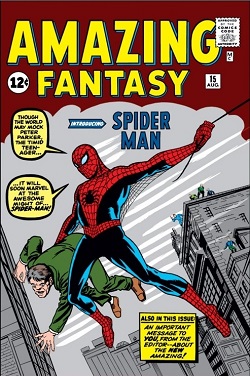
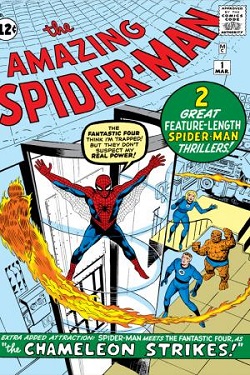
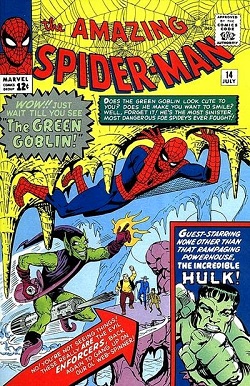
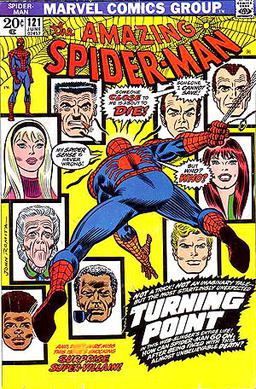
Covers shown to help you recognize the books. The characters and cover art are trademarks and copyrights of Marvel.
Original or Reprint?
The early stories were reprinted many times, and a reprint is worth far less than the original. Marvel Tales, a separate title, carries them inside its own covers. Newer copies print Marvel Milestone Edition or Facsimile Edition on the cover, and a 1966 book-and-record set reprinted #1 with no price on the cover. An original from the 1960s shows a 12¢ price; copies with a price in pence were printed for Britain and are collected separately.
About the Prices You See Online
The record prices in the news come from a handful of copies in near-perfect condition. Most family copies have creases, spine wear or a loose cover and sell for a small part of those records, although on the biggest Spider-Man keys that part can still be real money. That is why a worn copy deserves a photo rather than a guess. Outside our area? Key issues like these can also come to us by mail.
Graded Copies and Condition
Some collectors send important books to a grading company such as CGC or CBCS. The comic comes back sealed in a hard plastic case with a label showing its grade, which is a rating of its condition. We buy CGC and CBCS graded comics from the 1930s to the mid-1980s, so a few cased Spider-Man books mixed in with loose ones are welcome.
Most family collections have never been graded, and that is fine. Creases, spine wear, loose covers and a musty smell are common after decades in storage, and they do not automatically rule a comic out, especially an early issue. Our page on damaged comic books explains more. Please do not try to repair or clean anything.
Selling Online or Selling to a Local Buyer
You may wonder whether to list a Spider-Man issue on eBay. For a single valuable book, eBay can bring retail prices. It also takes time, careful photos, selling fees, packing and shipping, and some risk of returns. Repeating that for hundreds of books can stretch on for months.
We buy whole collections and resell the books to collectors over time, so you can skip all of that. If you would rather sell Amazing Spider-Man comics all at once, we make one offer for the collection, in person. Our comparison of selling on eBay or to a buyer lays out both sides so you can decide.
Found a stack of old Spider-Man comics? Old Comic Book Cover Prices shows how the price on the cover helps you tell roughly when a Spider-Man comic was printed. If they came from a relative’s home, What to Do With Old Comic Books covers the first steps.
How to Sell Amazing Spider-Man Comics to Us
Take a few photos of the covers or the open boxes and send them through our short contact form. Photos are preferred but not required. You do not have to identify, sort, grade or count anything, and submitting does not commit you to selling.
We then arrange a Free Collection Review by appointment. Smaller collections can be brought to one of our warehouse locations in New Jersey, Pennsylvania or Delaware. For larger ones, we review your photos and then come to you, so the boxes stay where they are. We buy collections in person within about a two-hour drive, and key issues by mail from farther away.
You can also call: (856) 438-8222 in South Jersey and Cherry Hill, (215) 390-0020 in Philadelphia and the PA suburbs, or (302) 414-0544 in Northern Delaware.
Other 1960s Marvel Titles We Buy
Most boxes hold more than one title. These guides cover the others we look for most.
Common Questions
How can I tell if my Spider-Man comics are old?
Check the cover price and the small print inside the cover. A 12¢ price or a 1960s date means an early copy, and a low issue number is another good sign.
What if my Amazing Spider-Man comics are torn or musty?
Send photos anyway. Early issues are wanted even in worn condition, so please do not throw them out or try to fix them.
Do you buy a single Spider-Man comic?
If it is a key issue, yes: a single book such as Amazing Spider-Man #129 is worth a photo on its own, and it can come to us by mail if you live farther away. Otherwise we focus on collections, so send photos of everything and we will look at it as a whole.
Do you buy Spider-Man comics from the 1990s or later?
Not on their own. We buy comics up to the mid-1980s. If newer Spider-Man comics are mixed in with older ones, we take the whole lot when we buy the collection.
Do I have to bring the comics to you?
No. Manageable collections can come to one of our warehouse locations by appointment, and for larger ones we arrange an in-person review at your location after seeing photos.
Local Comic Book Buyers Serving Greater Philadelphia
We buy in person, by appointment, within about two hours of our Cherry Hill, New Jersey base. Call the team closest to you.
South Jersey and Cherry Hill
Camden, Burlington and Gloucester counties and the rest of South Jersey.
Philadelphia and PA Suburbs
Philadelphia and the surrounding Pennsylvania suburbs.
Northern Delaware
Wilmington and the surrounding Northern Delaware communities.
Get a Free Collection Review
Send a few photos or call. Same-day cash, no sorting and no obligation to sell.